COHERE4DTraining-Free Dense Surface Alignment for
Coherent Metric 4D Human–Scene Reconstruction
Corresponding authors
Unable to load the teaser. Open video directly ↗
Abstract
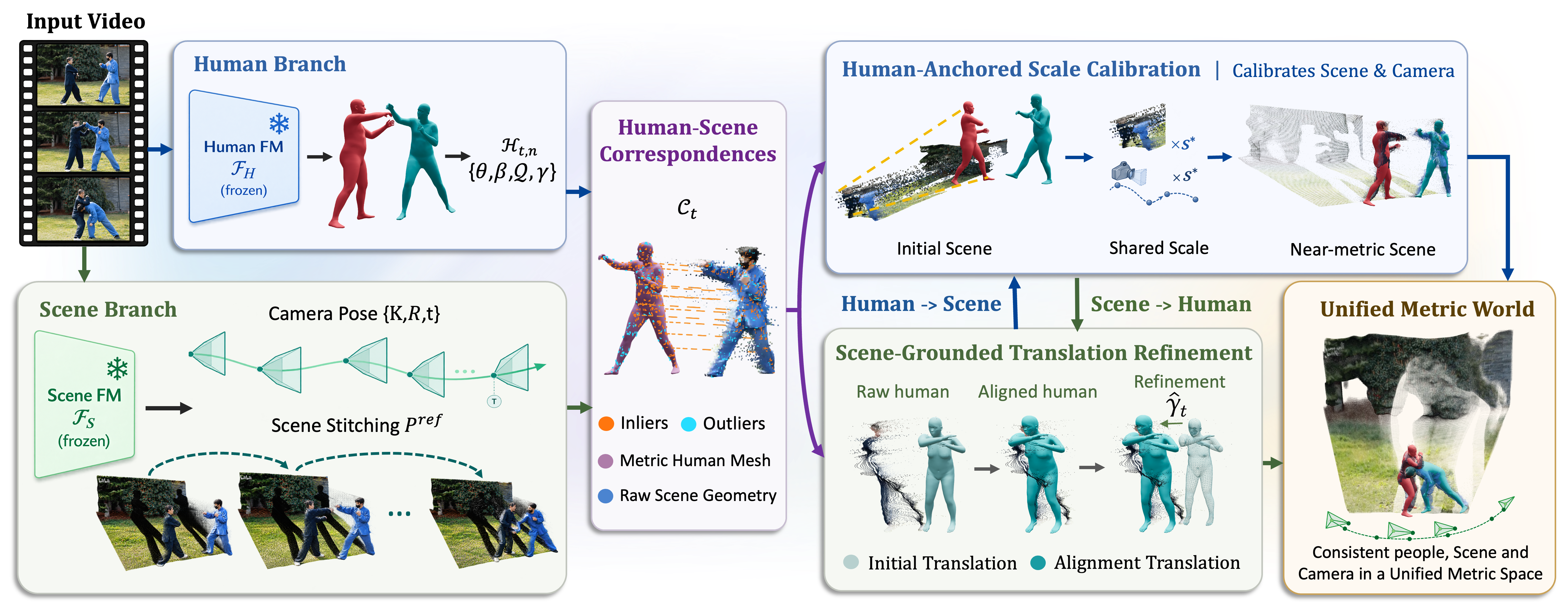
Human and scene foundation models offer complementary strengths for monocular 4D reconstruction: human models recover metric-scale body meshes but lack scene grounding, whereas scene models estimate globally consistent 3D geometry and camera motion without reliable metric scale. Crucially, both models reconstruct the same foreground human surface. Yet existing methods do not directly exploit this shared surface: lacking reliable foreground human geometry in scene reconstructions, earlier approaches either resort to sparse contact constraints or learn data-driven alignment modules that generalize poorly to out-of-distribution scenes. We present COHERE4D, a training-free framework that directly registers the human surfaces predicted by independently pretrained human and scene foundation models to reconstruct a coherent, metric 4D world. COHERE4D establishes dense, pixel-aligned 3D correspondences over the visible human surface and employs RANSAC with cross-frame consensus to suppress outliers from occlusion, background contamination, and depth noise. This formulation solves for two complementary geometric quantities: a sequence-level shared scale that calibrates scene geometry and camera motion to metric human size, and per-frame human translations that align camera-space human meshes with the scaled scene geometry to enforce spatial and temporal consistency. Across diverse backbones and benchmarks, COHERE4D substantially outperforms prior methods in human–scene alignment, metric scene and camera pose reconstruction, and global human motion estimation, adding only 4 ms/frame, enabling overall inference at up to 14 FPS.
Human–Scene Reconstruction
Given a monocular RGB video, COHERE4D reconstructs multiple people, dense scene geometry, and camera motion in a shared metric 4D world.
Unable to load this case.
Method
Human–Scene Alignment Comparison
Comparison with Human3R and UniSH on human–scene alignment.
Unable to load this case.
Global Human Motion Comparison
- Ground truth
- Ours
- Human3R
- UniSH
Unable to load this case.
Metric Scene and Camera Motion Comparison
COHERE4D uses reconstructed humans as metric anchors to calibrate scene geometry and camera trajectories. Our calibration brings predictions from scene foundation models closer to the ground-truth metric scale.
- Ground truth
- Ours Scene
- Ours Camera
- Raw Scene
Unable to load this case.
Ablation Study
Effect of Human-anchored Scale Calibration
Scale calibration recovers the raw scene prediction toward the ground-truth metric scale.
- Ground truth
- Ours Scene
- VGGT-Ω raw scene
Unable to load this case.
Effect of Scene-grounded Translation Refinement
Translation refinement improves human–scene alignment and contact.
Unable to load this case.
More Occlusion Results
Unable to load this case.
More Interaction Results
Unable to load this case.
More Internet Video
Unable to load this case.
Citation
@article{wang2026cohere4d,
  title={{COHERE4D}: Training-Free Dense Surface Alignment for Coherent Metric {4D} Human-Scene Reconstruction},
  author={Wang, Zhumei and Wang, Shaofei and An, Xiang and Pei, Mingtao and Huang, Siyuan},
  journal={arXiv preprint arXiv:2611.32482},
  year={2026}
}